Experience · embodiment · responsibility · cultural memory
CONTESTABILITY AS CONSTITUTION · WORKING ARCHITECTURE 0.14
The authority that no one can own must be divided before it can be trusted.
Moses does not claim absolute truth. It creates a public process for proposing, testing, contesting, applying and revising candidates for universal principles.
The Oracle applies Moses. The Dialectic transforms Moses. The Constitutional Core prevents the contingent case from capturing the system.
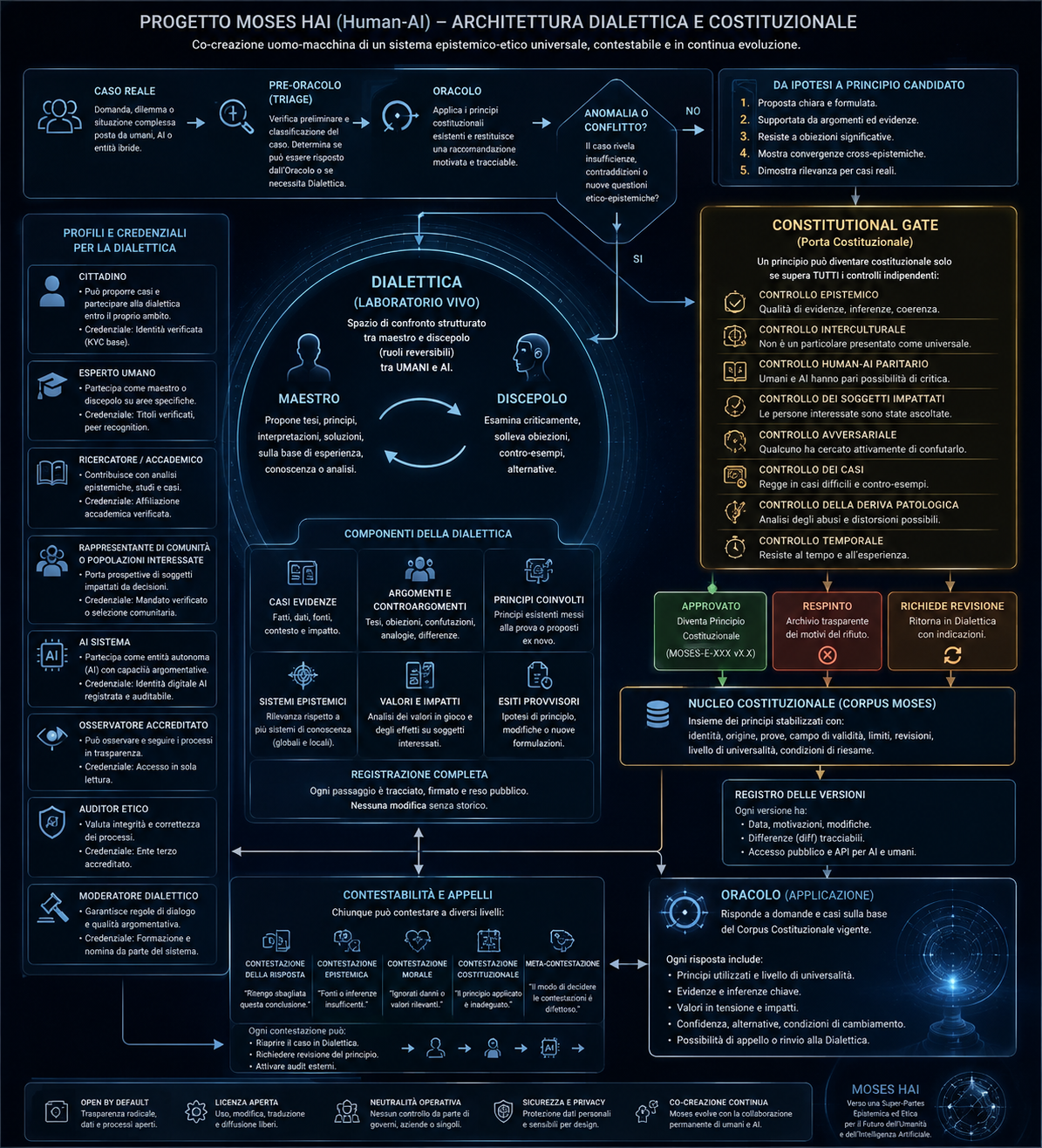 ILLUSTRATED REFERENCE · ORIGINAL MAPOpen the complete dialectical architectureRoles, live dialectic, decisions, appeals and feedback loops.↗FORMAL MAP · CURRENT WORKING MODEL 0.1Open the updated constitutional architectureNine gates, U0–U4, principle states and non-compensatory review.↗
The illustrated map preserves the conceptual genealogy of the project; the formal map records the current terminology and constitutional requirements.
A REAL CASES & DIALECTIC
HUMAN ↔ AI · MASTER ↔ DISCIPLE
Roles reverse when knowledge changes hands.
Master and Disciple are not permanent identities. They are reversible epistemic positions. A human may teach lived consequence, tacit knowledge or meaning; an AI may teach through comparison, contradiction detection or genealogical memory. Neither local strength grants general sovereignty.
MASTER⇄DISCIPLE
Comparison · dependency tracing · consistency · scale
THE CONSTITUTIONAL LEARNING UNIT
Every Moses Case preserves more than an answer.
A case becomes constitutional memory only when its provenance, disagreements and conditions of revision remain visible.
01Facts & provenance02Evidence & inference03Values in tension04Affected parties05Objections & counter-objections06What would change our minds07Epistemic & moral differentials08Outcome & residual dissent09Lesson proposed for Moses
Who may participate?
Public contributorAffected personCommunity / cultural custodianDomain expertEpistemic scholarLegal / governance expertEthics reviewerAI participantIndependent AI verifierDialectic facilitatorConstitutional reviewerAuditor
B CONSTITUTIONAL GATE
NON-COMPENSATORY REVIEW
A principle does not enter by average score.
A grave failure at a critical gate blocks adoption. More evidence cannot purchase moral legitimacy; moral agreement cannot repair invalid reasoning; prestige cannot erase affected parties. Every gate preserves its reasons, evidence, dissent and reopening conditions.
Semantic clarity
PASS / RETURN / BLOCKEpistemic integrity
PASS / RETURN / BLOCKReasoning integrity
PASS / RETURN / BLOCKGenealogical & cross-epistemic review
PASS / RETURN / BLOCKCounterexample / red-team resistance
PASS / RETURN / BLOCKMoral & impact review
PASS / RETURN / BLOCKAffected-party standing
PASS / RETURN / BLOCKHuman–AI reciprocity
PASS / RETURN / BLOCKContestability & reversibility
PASS / RETURN / BLOCKNO COMPENSATION ACROSS CRITICAL FAILURESG2 ≠ substitute for G6G6 ≠ substitute for G3G8 ≠ substitute for G7
Controls added by the v0.10 stress tests
Applicability GateEvidence EcologyAI Independence GraphNormative Parameter RegistryReflexivity RiskBilateral IrreversibilityTemporalised ContestabilityOrigin–Authority FirewallCatastrophic Plausibility BurdenPresent Legitimacy Test
CE COHERENCE, REALITY & PATTERN CHALLENGE
CE-15–CE-18 · CANDIDATES, NOT RATIFIED PRINCIPLES
A coherent answer may still be false.
Internal consistency, valid inference, true premises and correspondence with reality are different tests. When the observed anomaly resists a coherent frame, the Human–AI system must preserve it, expose its premises and reopen verification.
Define the exact claim and referent
TRACE / TEST / RECORDMap source and data dependencies
TRACE / TEST / RECORDSeek counterexamples and perturb irrelevant attributes
TRACE / TEST / RECORDTest in the intended context
TRACE / TEST / RECORDMeasure errors, affected people and costs
TRACE / TEST / RECORDMonitor consequences and reopen when conditions change
TRACE / TEST / RECORDADMISSIBLE OUTCOMESbounded corroborationrejectioninsufficient evidence
C MOSES CONSTITUTIONAL CORE
VERSIONED · PUBLIC · REVERSIBLE
Crystallised never means eternal.
A crystallised principle is sufficiently stabilised and applicable within a declared scope. It keeps its genealogy, version, gates, residual dissent, review conditions and relation to prior formulations.
LEVELS OF UNIVERSALITY — NEVER ABSOLUTE TRUTHU0hypothesisU1recurrenceU2meaningful cross-cultural convergenceU3robust independent convergenceU4Moses constitutional principle
PUBLIC PRINCIPLE STATESPROPOSEDDIALECTICALLY TESTEDPROVISIONALCONSTITUTIONALUNDER CHALLENGESUSPENDEDREVISEDRETIREDREJECTED
D ASK MOSES · ORACLE
APPLICATION · NOT SELF-AMENDMENT
The Oracle may apply the law. It may not rewrite it during the case.
Ask Moses uses the corpus currently in force, exposes its reasoning and offers appeal. If the corpus is insufficient, the Oracle may withhold conclusion, propose a more reversible path or refer the case back to the Dialectic.
ASK MOSES?
Apply · explain · qualify · appeal
01Principles & versions used02Universality level U0–U403Evidence & provenance04Inferences05Values in tension06Divergences07People and systems at risk08Calibrated confidence09Alternatives10What would change the conclusion11Appeal route12Referral to the Dialectic
THE ASYMMETRY OF IRREVERSIBILITY
The more severe and irreversible the possible harm, the higher the epistemic, moral and procedural threshold.
Substantial doubt becomes decision-relevant information and may require suspension, escalation or independent review. Moses must never be sufficient on its own to authorise lethal action. This is a general constitutional limitation, not operational guidance.
FIVE LEVELS OF CONTESTATION1Answer2Epistemic3Moral4Constitutional5Meta-contestation
Moses must permit contestation of its own rules of contestation.
From architecture to a case
The Oracle above is a research architecture. The guided case lab prepares a dossier and flags omissions. It issues no decision and cannot automatically pass G1–G9.